LIVING IN THE DEADZONE
Can you hear me now? Not good! Putting a spin on the infamous Verizon commercial which showcased the network’s connectivity even in the most remote places, a growing number of travellers are looking to disconnect while travelling to truly switch off, unplug and unwind.
“We live in a world where being constantly ‘on’ is the default, which is why ‘deadzoning’ has resonated so strongly with our community. People are experiencing genuine digital fatigue and realizing that social media offers only an illusion of connection,” says David Green, VP of Customer Sales and Operations & Managing Director, Canada for G Adventures. “True engagement requires real-world presence, whether that’s sharing conversations with local hosts, stepping into nature or bonding with fellow travellers instead of chasing likes and shares.”
As a result, an increasing number of Canadians are disconnecting from their devices while travelling as a means to improve their mental wellbeing and reduce stress levels. While some people take trips to remote off-the-grid places with little-to-no cell service or WiFi, others are intentionally choosing to switch off their devices or limit exposure to social media or work notifications while away.
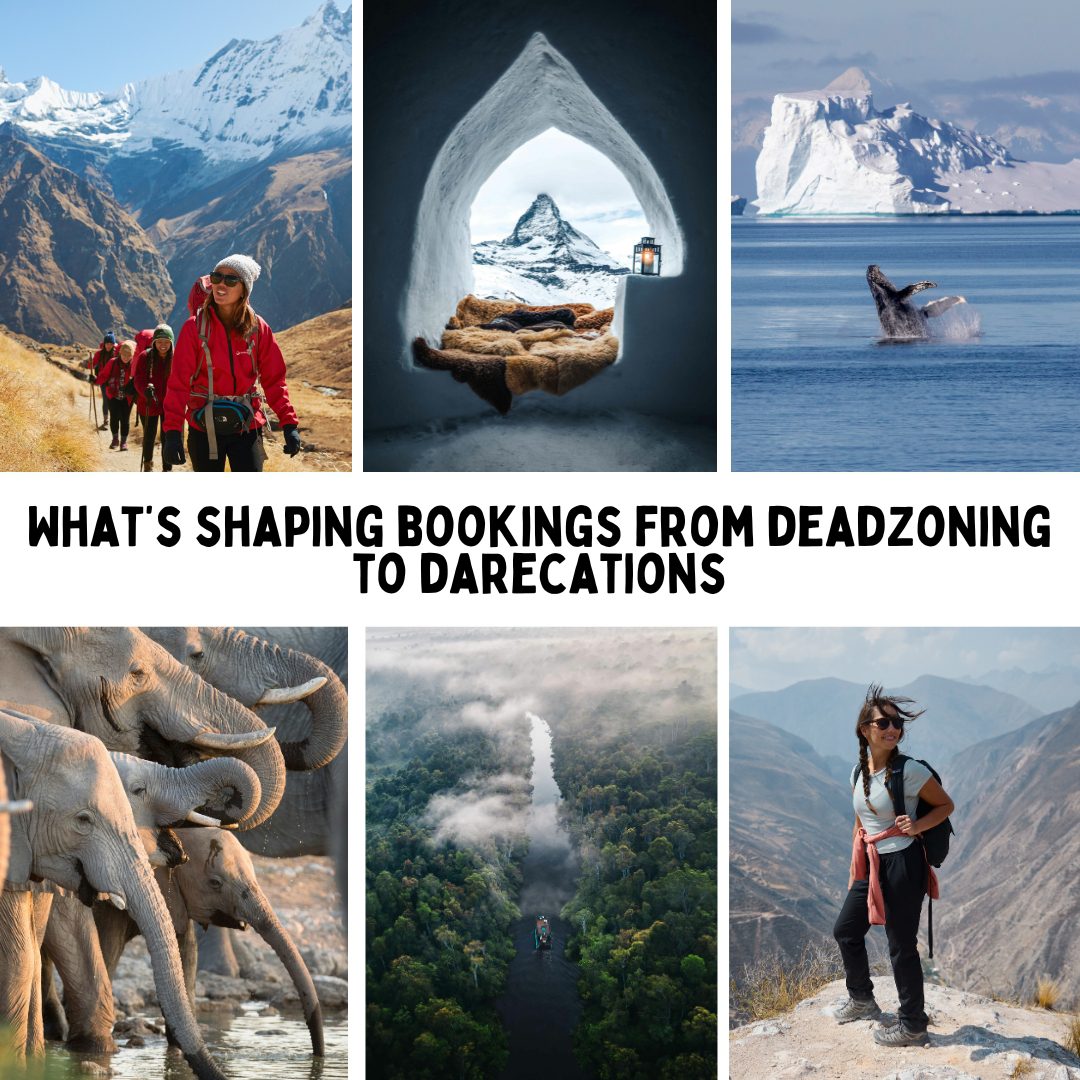
For clients looking for trips that easily lend themselves to deadzoning, G Adventures offers itineraries to the likes of Antarctica, Patagonia, Namibia and the jungles of Ecuador.
THE CHANGING FACE OF BOOKING WINDOWS
While in some instances Canadian travellers are locking in trips further in advance, in others, last minute bookings are trending.
“Two distinct patterns are emerging. Sun vacations are being planned earlier and more firmly,” shares Anita Emilio, Executive Vice President and General Manager of Flight Centre Canada. “In our recent YouGov study, thirty-one per cent of Canadians say they plan to book earlier than usual, and we are seeing that most clearly in Caribbean and Mexico bookings. Families tied to Christmas and March Break want certainty, particularly now that Cuba’s affordable inventory is no longer available.”
On the other hand, booking to Europe is showing the opposite pattern with shorter booking windows and more wait-and-see behaviour.
“Travellers still want to go, but with costs varying significantly by destination and travel period, many are monitoring airfares and packages before committing,” she adds. “Those with greater flexibility can adjust their timing or destination if the price does not feel right.”
STEPPING OUT OF THE COMFORT ZONE
Say goodbye to doing absolutely nothing on vacation and say hello to adventure. Pinterest has identified ‘darecations’ as a key trend for the year, highlighting that people are travelling for the thrill of it. In particular, Gen Z and Millennials are seeking adrenaline-inspired tourism activities such as whitewater rafting and rappelling down waterfalls.
The segment that is most likely to be interested in ‘darecations’ would be what the Adventure Travel Trade Association defines as “Adventure Intensives” – travellers who seek high-energy, thrill-oriented or physically immersive activities. While they represent a smaller 14% of the global market, a broader 67% of international travellers now describe themselves as “Open to Adventure,” showcasing the rise of adventure travel in the market.
“We define adventure travel more broadly than what the term ‘darecation’ suggests. Our framework is built around three pillars: activity, nature, and culture. While adrenaline-fuelled experiences certainly play a role, they represent just one segment of a much larger and more nuanced market,” explains Heather Kelly, Director of Research. “Adventure travel has moved from a niche built around technical, adrenaline-heavy activities to a mainstream mindset.”
The association’s 2025 research valued the global adventure travel market at $1.16 trillion, up from $683 billion in 2017, and it expects it to approach $2 trillion by 2032.
“What is driving terms like ‘darecation’ is a shift in motivation,” Kelly continues. “Travellers increasingly frame a trip around challenge, personal growth, and a story worth sharing. In our 2026 operator survey, operators flagged ‘adventure as a status symbol’ as a rising consumer motivation, alongside the top two we track, seeking new experiences and getting off the beaten track.”
THE PRICE IS RIGHT
Flight Centre Canada’s Emilio also notes that affordability is the driving force behind current booking patterns.
“Forty-nine per cent of Canadians say overall cost is their top consideration when choosing a destination. Increasingly, they are assessing the full cost of the trip—what their dollar buys once they arrive—not airfare alone. Advisors who can help clients compare that full picture are having more productive conversations,” she reveals.
Notably, Christian Wolters, Intrepid Travel’s President, Canada, shares that while Canadians are scrutinizing their spend more carefully, they’re still prioritizing travel.
“It’s not about finding the lowest price, it’s about making sure the experience feels worth the investment,” he reveals. “That’s a big reason we’re seeing strong momentum behind our Premium range which grew 19% year-over-year in 2025. In response, we’ve continued expanding the offering with new trips in destinations like Greenland, Norway and Costa Rica. Travellers are willing to invest more when they know the planning, logistics and details are taken care of, giving them more time to focus on the experience itself.”
ALL IN THE FAMILY + NONNA-MAXXING
Interestingly, one area where Canadians are spending more money is for family travel.
“Parents want to create meaningful experiences with their children, but they also know family travel can come with a lot of stress. In fact, 83% of Canadian parents say they experience real stress when travelling with their children, and their top worry is something going wrong. That’s where organized small-group travel adds value: it removes the planning burden while still delivering the cultural connection and shared experiences families are looking for,” Wolters shares, adding that the tour operator’s Premium Family range is responding to that demand with more inclusions, more comfort and more support. “Families can spend less time managing logistics and more time making memories together, and book confidently.”
For advisors, the opportunity is to reframe the conversation around value, not just price.
“Clients are still ready to travel, but they’re looking for confidence that their investment will pay off,” he shares. “Longer booking windows are returning for premium and bucket-list trips, so advisors have an opportunity to start those conversations earlier and position experiences that offer more support, inclusions and peace of mind.”
Flight Centre Canada says nonna-maxxing is finding its way into the travel industry as many Canadians are reconnecting with older generations. What initially started as a social media trend is now resulting in travel that reconnects people with their family history, ancestry and cultural heritage.
“A faded photo, an old address or story shared at a family gathering can suddenly come to life when you’re standing in that place yourself,” said Emilio. “Roots travel turns family history into something you can see, experience and share with the people who remember it.”
A global survey from Flight Centrefound that 79 per cent of Gen Z and 80 per cent of millennials have travelled, or would consider travelling, with multiple generations of their family. To learn about family history; to understand cultural identity; to visit ancestral places or regions and to strengthen family bonds are among the top things driving Gen Z and millennials to book heritage trips.
IT’S ALL ABOUT THE EXPERIENCE
Notably, travellers are also going deeper when they’re travelling.
“Canadian travellers are increasingly seeking meaningful experiences rather than traditional sightseeing,” says Nathalie Tanious, President & CEO of H.I.S. Canada Travel Inc., parent company of travelbrands. “Interest in culinary travel, wellness escapes, outdoor adventures, cultural immersion, and small-group tours continue to grow, particularly among younger travellers who value authentic and memorable experiences.”
While frequent smaller journeys was a big trend coming out of the pandemic, Tanious shares that now many Canadians are opting for fewer but longer vacations.
“Rather than taking multiple short trips throughout the year, travellers are planning one extended holiday, allowing them to get greater value from their airfare and overall travel investment,” she adds.
CONFIDENCE IS BUILDING
After a lot of uncertainty surrounding fuel prices and conflicts, Katy Rockett, Explore Worldwide’s Regional Director of North America, reveals that consumer confidence is returning.
“It’s great to see so many Canadians getting back out there and travelling,” she says. “With the uncertainty around fuel prices in recent months, people were understandably more cautious about their travel plans, so it’s exciting to see interest building again, especially for more off-the-beaten-path destinations that are gaining popularity with Canadian travellers.”
Rockett said that the tour operator saw a significant number of last-minute bookings for summer and shoulder-season trips to its most popular European destinations, including Italy, France, Portugal, and Greece.
“I think many people who hadn’t planned earlier in the year are getting the itch to get out there and travel,” Rockett says. “Looking beyond the peak summer months, we’re also starting to see more Canadians planning ahead for 2027 adventures a bit further afield, with destinations such as Tunisia, Thailand, Vietnam, and Algeria gaining interest. I expect this trend to continue as we move into the second half of 2026 and travellers look to fill their calendars for next year.”
Intrepid Travel’s Wolters highlights that advisors also can tap into the demand for group touring.
“I think the biggest opportunity for advisors right now is recognizing how much demand there is for small-group travel and helping clients understand the value it provides,” he adds. “Canada continues to be one of Intrepid’s fastest-growing markets, and we’re seeing that travellers are willing to invest when they have confidence the experience will deliver.”
On a similar note, Scott Nisbet, president and CEO of Globus family of brands, highlights that a growing number of travellers are booking with tour operators and river cruise lines instead of on their own.
“Overall, Canadians are bullish on 2027 river cruising and touring, up 20% overall compared to this time last year,” he notes.
Highlights for the increase in demand are touring in Asia, which is up 81% YOY; winter touring, up 57%; touring in Europe, which is up 39% for Globus and Cosmos, and 23% for Avalon. Demand is also growing for touring in the South Pacific, up 20%.
“These healthy gains can be attributed to growing confidence in the market, touring and river cruising demand created by new-to-industry travel advisors, and energy around new products for 2027,” says Nisbet.